Domingo, 27 de septiembre de 2026



Temas del momento:
Venezuela Demografía Crisis en Ceuta Hacia 2027 "Ley de nietos" Redes sociales y menores Diane Coyle
AGENDA PÚBLICA EU
Javi López and Rosa Balfour: "Europe faces unprecedented pressure on its sovereignty"
In an international landscape marked by uncertainty, the director and editor of Agenda Pública, Marc López Plana, travels to Brussels to speak with Javi López, Vice-President of the European Parliament, and Rosa Balfour, Europe Director at the Carnegie Endowment for International Peace. Both agree that the European Union is facing unprecedented pressure on its sovereignty and point to a series of strategic challenges the Twenty-Seven will have to confront in the coming months.
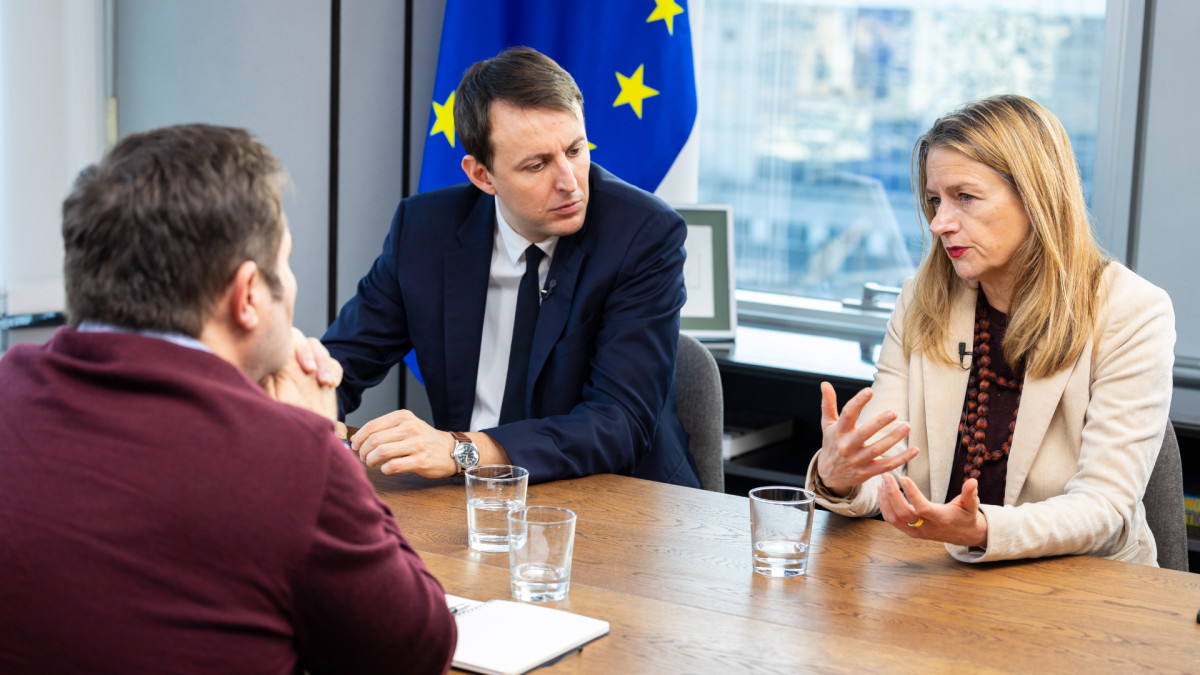
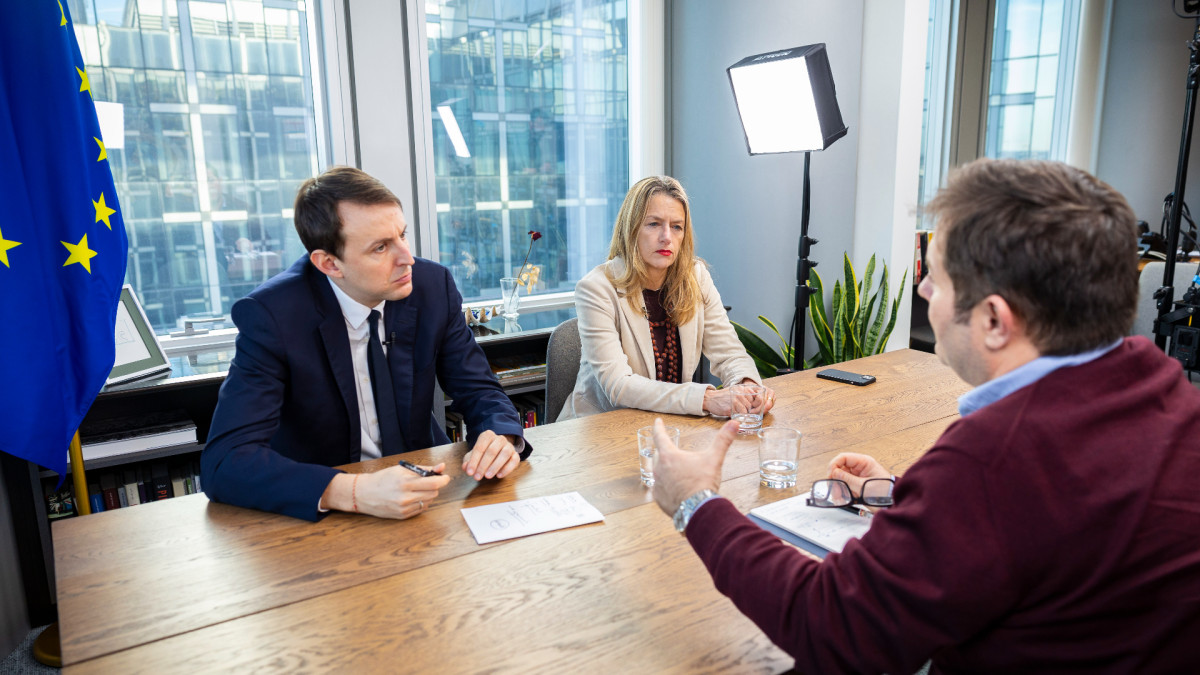
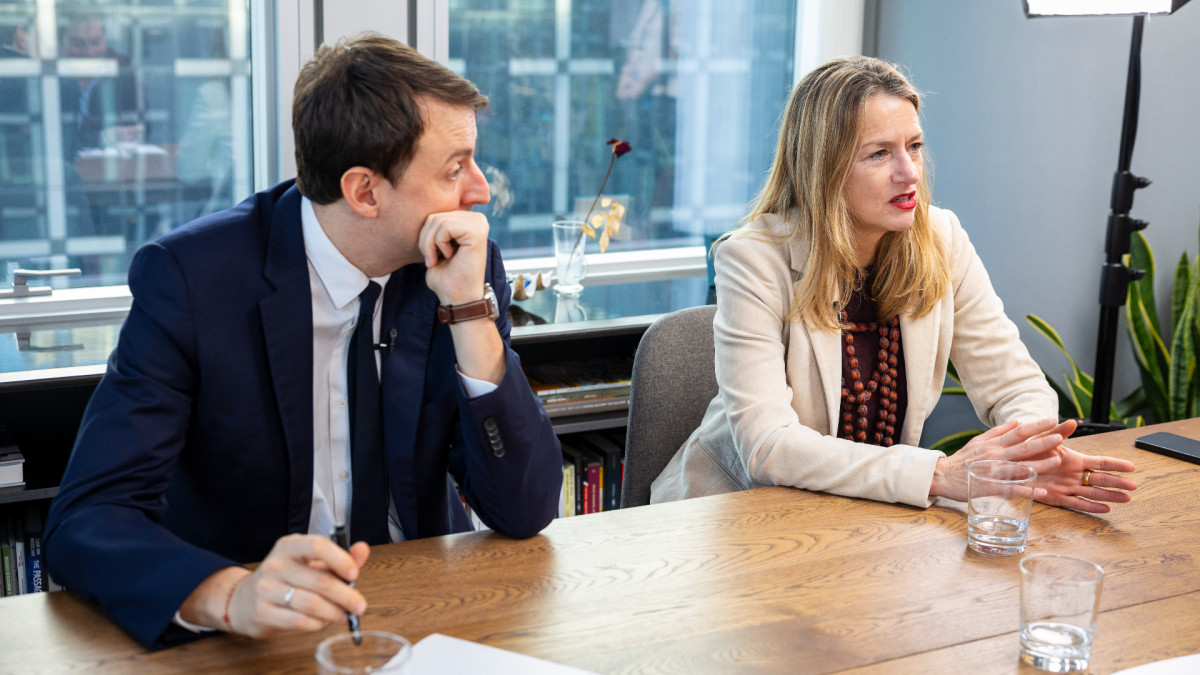
The director and editor of 'Agenda Pública' Marc López Plana (left), alongside European Parliament Vice-President Javi López (centre), and the head of Carnegie Europe’s research office, Rosa Balfour (right).Agenda Pública / Bru Agency
"The security umbrella, democratic loyalty, values and principles… they are no longer there," warns Javi López, Vice-President of the European Parliament, describing the collapse of transatlantic relations that for decades formed the backbone of the international order. For Rosa Balfour, Europe Director at the Carnegie Endowment for International Peace, "the stars have aligned in a very anti-European way," and the aim is "to undermine the community of law on which the European Union has been built."
Both agree that Europe is facing "unprecedented" pressure on its sovereignty and warn that the strategy pursued so far — appeasement — "did not work." In a context marked by internal fragmentation and the advance of the radical right, the conversation, part of the Agenda Pública EU section, examines how the European Union can protect its security, its democracy and its political model in a world where, as López notes, "power politics has returned."
Let’s talk about how the relationship between Europe and the United States is changing.
Javi López (J. L.): We are seeing how it’s collapsed in transatlantic relations after eight years, when it was the backbone of our position in the world and probably the backbone of international relations. The security umbrella, the democratic loyalty, the values and principles, the way the United States operated in foreign policy: it’s not there anymore.
This is the reality. We have to face it as it is, and stop pretending it isn’t happening or that it will simply disappear. That won’t work for us. The world is changing.
We are under unprecedented pressure on our sovereignty coming from the East and the West, affecting our interests, values and security. We have to act in this scenario.
Rosa Balfour (R. B.): I agree. In the United States, the stars have aligned in a very anti-European way. President Trump himself does not like the European Union at all, and he has several allies in his coalition who agree with that.
In addition, there is an ideological alignment to subvert the European Union through support for radical right parties that are Eurosceptic. The goal is basically to undermine the community of law on which the European Union has been built, and to prefer bilateral relationships with individual countries. That is the same strategy China and Russia have been pursuing: to divide Europeans.
Brexit was a success for these political forces. And the goal now is to keep pursuing policies that break up the single market, the rules and regulations the European Union produces, and the solidarity Europeans have, with difficulty, built over decades of integration.
This is January 2026. It’s time for Europeans to change the strategy they came together around in 2025: appease Trump, bring him gifts, and try to buy time while building greater autonomy in security.
Appeasement didn’t work, and building greater autonomy in security is very hard. It will still take time. But it needs to be accompanied not just by defense spending: it needs a real plan for defense integration, for making our security more efficient and better integrated, and for using the economic toolbox the European Union has to deter, to negotiate, to de-escalate, and to retaliate if need be.
Europe needs more unity, but we’re seeing more fragmentation in member states and in the European Parliament, with far-right parties gaining ground. How can the EU respond in this political context?
J. L.: We saw that the United States doesn’t want a regime change in Venezuela. But we’re sure they want to change the regime in Europe. They want to change our basic consensus: the consensus on which our democratic coexistence, our rights and our social model are based. And they are saying so explicitly.
This is not what we think; it’s what they are saying officially as a foreign policy. They detest what we represent in the world: rules-based societies, a rules-based order. Not only citizens’ rights, but also multilateralism and cooperation against power politics. The European Union was created with the idea that we don’t have power politics anymore in Europe. But the reality is: power politics is back.
And, of course, this is disruptive for our policymaking process. We need not only unity between member states, but also between the main European political families.
Our balance of power is more fragile than ever. We see it especially in Parliament, because debates are more high-voltage. But we need to overcome this fragility between member states and political families: act united, have strategic clarity, and act firmly, with enough courage.
Because it has been mentioned: the strategy we followed last year, appeasement, has failed: the agreement in Scotland, the 5% without discussions, etc. We have to spend more on security, obviously, but that agreement was made under other optics. Everything we did last year was built under that assumption, and appeasement didn’t work. That’s why we have to adapt, and adapt fast.
Same question for you, Rosa, and let me add one more: what role has Ursula von der Leyen played in this?
R. B.: The debate in Brussels over the past six months is who to blame: member states or von der Leyen. But it’s a bit of a false debate, because von der Leyen was not alone in advocating appeasement. She had the backing of the EU member states. Otherwise, she wouldn’t have been able to pursue that.
We still see today that member states are wondering whether to activate the toolbox to respond to economic coercion from a foreign power: the anti-coercion instrument. EU leaders are going to meet on Thursday evening after Davos — after Trump’s speech and after attempts to de-escalate diplomatically — to decide whether to activate it or not.
It’s not as if someone is saying: "We want to pull out all euro savings from American banks." That’s not what the instrument is, and it’s not what activating it means.
But the fact that there are still so many differences among member states suggests the deeper problem: there is no unity on what transatlantic strategy to pursue. And there are several shades of positions among countries — it’s not two or three camps — which makes the calculus very difficult.
Commissioner Kubilius has started talking about the need for a European army. Is he putting that idea forward on his own, or is someone pushing him to put it on the table?
J. L.: I think he is trying to send a political message: that the horizon for Europe has to be taking full responsibility for our common security with our own common instruments. That’s what he’s projecting with the proposal.
A European army is something I would love to see one day. But it’s basically talking about the last piece of the castle when you haven’t started working on the pillars of the house. There are many things to do before we get there.
Interoperability is a problem. Our defense industry and our dependency are a problem. Coordination on intelligence and shared intelligence is a problem. We can do more. We can spend more on security. The last step of this long journey would be imagining a European army. But we have to spend better, and we have to spend more European.
R. B.: Totally. Now that we’re talking about increasing defense spending, for European citizens it’s really important to know that this money is well spent.
We don’t want Spain, France, and Germany all to buy the same things. They need to buy things that can work together, so we can focus on what is called interoperability. That creates efficiencies in cost, but also in deterrence and in action, if need be.
The European army is a recurrent theme. If you go back to the 1950s, the original idea was to create a defense community, which didn’t pass in the French Parliament. But that was where the whole idea of European integration started from. Then 10 or 15 years ago, Jean-Claude Juncker also talked about a European army.
It’s one of those myths that is going to be really hard to implement, because you need bottom-up integration before you can even imagine a European army. And sometimes that idea has actually backfired.
In Juncker’s case, it was very present in the Brexit debate. For some British voters, the idea reinforced the perception of Europe as a supranational force that was going to demolish national identity. It fed Euroscepticism.
A European army presupposes a movement towards a federal Europe. We’re not there. I don’t see any political leader willing to invest in that right now. In fact, quite the contrary: national leaders are downplaying the European Union.
None of them are willing to go out and face the electorate on a pro-European platform. That’s one of the problems we have. It’s not just the radical right parties: even the pro-European parties are not saying it loudly. And that needs to change.
Let’s talk about national leaders: it’s not the same voice from Giorgia Meloni, Pedro Sánchez, Friedrich Merz, or Emmanuel Macron. How do these different positions affect Europe’s ability to build unity?
J. L.: We have a diverse Europe, politically and geographically. At the same time, Spain has continued contributing to key decisions made by the European Council and by Europe.
In any case, we have to find a collective way to produce common answers to this situation: to increase our deterrence — including deterrence vis-à-vis the United States — and to face what is an existential threat for our security: Ukraine.
This is the reality. We have a diverse Europe, it’s true. But our prime ministers have to find a way to produce answers, especially this year, because next year will be a very electoral year in Europe.
Poland, France, Italy…
J. L.: And Spain. Four out of five biggest countries. That will make decisions even more difficult next year. That’s why this year is the year to move forward on protecting our sovereignty and to change what we see is not working. Now is the time to deepen the Single Market, our strongest instrument to boost competitiveness and prosperity, and to diversify our international alliances and partnerships.
We also need to strengthen the protection of our democracy against foreign interference, enforce digital market regulation, and mobilise both private and public investment towards innovation and our strategic objectives.
This is precisely why our debate on the European budget is so crucial.
R. B.: Of the five countries you mentioned, four of their leaders come from different political families. It’s always going to be difficult to find agreements.
Beyond that, Macron has been prominent in the debate about the future of Europe, but he doesn’t have sufficient backing at home. Then we see Chancellor Merz. Germany has always been very pro-European, but Merz is not really investing heavily in rhetorical support of Europe. He frames what needs to be done as something for Germany, not for Europe. That is a change in the way German politicians talk about domestic reforms, and it’s a problem.
The Italian Prime Minister, Meloni, speaks two, three, four different languages politically. She’s pro-Trumpian — a Trumpian — and then she says things to keep her role in the European framework. She’s very good at double speak, but she is not pro-European. Her commitment to Europe only goes as far as Europe delivers what she wants.
Italy is benefiting enormously from the Next Generation recovery plan set in motion because of COVID, under the previous government. She has room for maneuver and strong polling. The others are fighting the challenge from the radical right. She is the radical right, so she doesn’t have that problem.
Let’s stay with that.
J. L.: One of the challenges is the story of German mercantilism, and a historical discomfort with power politics. They see power politics as something ugly. Foreign policy becomes about buying cars and selling energy. But we have to adapt to a new reality.
And with Germany, but also with the East of Europe, we have to face a reality: transatlantic relations are part of national identity. It’s not just foreign policy.
Poland, for example.
J. L.: And it’s something to respect, but also something that has to change. The current situation mandates not only policy changes, but also a mindset change. And changing mindset is always harder than changing policies, especially when it’s tied to national identity, and especially for people for whom the transatlantic relationship explains the existence of your country and your democracy.
And then we have Meloni’s double cards. That may have been useful last year, but taking into account the situation we are facing with Greenland, it’s not possible anymore.
On that, I think Spain played a really consistent position last year, backed by Spanish society, a really pro-European. Europe first. International law as our guide in the international scenario. We cannot use different standards for Ukraine, Gaza, Venezuela, the United States, and so on — something we saw last year. And we have to be firm with our American friends.
Let’s move to Ukraine. Could a peace agreement include a fast track for Ukraine to join the European Union? Would that be the real test for Europe?
R. B.: I agree that Ukraine’s accession to the European Union is a real test for Europe. But I don’t think it’s going to be a key element of whatever ceasefire agreement is reached. The key will be security guarantees.
Accession to the European Union can be interpreted as a security guarantee, but that’s not what Ukraine wants, and it’s not what would prevent Russia from invading again. And indeed, if Ukraine joins the European Union, Russia claims to be agnostic.
But that’s what Moscow says now. That’s not the issue. The real issue is security guarantees.
There is discussion about whether Ukraine could have some accelerated path to accession. I don’t think that’s possible politically and legally, and it will probably cause more problems than it solves.
We also need to be aware that enlargement has gone through many political challenges, including vetoes by individual EU members — not only on Ukraine, but also on the Western Balkans.
That’s why the idea of gradual integration is taking hold. It means countries that aspire to join can join parts of the acquis and get some rights as they do so, but not all of them until they complete the whole process and there is a political understanding.
That’s the realistic scenario — slightly optimistic too, because it requires all countries to agree. But it’s more realistic than a quick path for Ukraine while the Western Balkans and Moldova stay out. Even geopolitically, I don’t think that’s realistic.
One last topic: China. We’re talking a lot about the United States, but in 10 years, will we talk about China in the same way?
J. L.: It’s possible, but our relations are completely different. Our security was built over the last years under the American umbrella. Even our international position and identity was built partly thanks to Atlantic relations. Our relations with China are not the same.
What is extremely important now, and I want to end with this, is to avoid at any cost the reflex of "the West and the rest". I sometimes see that reflex in Brussels. A worldview of "the West versus the rest", which partly reflects a Cold War mindset, would be a direct path to isolation.
Carney made good points in Davos: not picking blocks, explicitly, but defending our interests. Not being naive with China, defending our interests with China, but defending our interests in this new international scenario includes work in our relationship with China.
Thank you both.
Both agree that Europe is facing "unprecedented" pressure on its sovereignty and warn that the strategy pursued so far — appeasement — "did not work." In a context marked by internal fragmentation and the advance of the radical right, the conversation, part of the Agenda Pública EU section, examines how the European Union can protect its security, its democracy and its political model in a world where, as López notes, "power politics has returned."
Marc López Plana, editor and director of Agenda Pública, asks during the conversation. Foto: Bru Agency
Let’s talk about how the relationship between Europe and the United States is changing.
Javi López (J. L.): We are seeing how it’s collapsed in transatlantic relations after eight years, when it was the backbone of our position in the world and probably the backbone of international relations. The security umbrella, the democratic loyalty, the values and principles, the way the United States operated in foreign policy: it’s not there anymore.
This is the reality. We have to face it as it is, and stop pretending it isn’t happening or that it will simply disappear. That won’t work for us. The world is changing.
We are under unprecedented pressure on our sovereignty coming from the East and the West, affecting our interests, values and security. We have to act in this scenario.
Rosa Balfour (R. B.): I agree. In the United States, the stars have aligned in a very anti-European way. President Trump himself does not like the European Union at all, and he has several allies in his coalition who agree with that.
In addition, there is an ideological alignment to subvert the European Union through support for radical right parties that are Eurosceptic. The goal is basically to undermine the community of law on which the European Union has been built, and to prefer bilateral relationships with individual countries. That is the same strategy China and Russia have been pursuing: to divide Europeans.
Brexit was a success for these political forces. And the goal now is to keep pursuing policies that break up the single market, the rules and regulations the European Union produces, and the solidarity Europeans have, with difficulty, built over decades of integration.
"It’s time for Europeans to change the strategy they came together around in 2025: appease Trump, bring him gifts, and try to buy time while building greater autonomy in security"We, as Europeans, have received multiple wake-up calls. We’ve also seen the United States violate international law, for instance with the operation in Venezuela, and threatening to do so over Greenland.
This is January 2026. It’s time for Europeans to change the strategy they came together around in 2025: appease Trump, bring him gifts, and try to buy time while building greater autonomy in security.
Appeasement didn’t work, and building greater autonomy in security is very hard. It will still take time. But it needs to be accompanied not just by defense spending: it needs a real plan for defense integration, for making our security more efficient and better integrated, and for using the economic toolbox the European Union has to deter, to negotiate, to de-escalate, and to retaliate if need be.
Europe needs more unity, but we’re seeing more fragmentation in member states and in the European Parliament, with far-right parties gaining ground. How can the EU respond in this political context?
J. L.: We saw that the United States doesn’t want a regime change in Venezuela. But we’re sure they want to change the regime in Europe. They want to change our basic consensus: the consensus on which our democratic coexistence, our rights and our social model are based. And they are saying so explicitly.
This is not what we think; it’s what they are saying officially as a foreign policy. They detest what we represent in the world: rules-based societies, a rules-based order. Not only citizens’ rights, but also multilateralism and cooperation against power politics. The European Union was created with the idea that we don’t have power politics anymore in Europe. But the reality is: power politics is back.
"We need to overcome this fragility between member states and political families: act united, have strategic clarity, and act firmly, with enough courage"To respond, we will have to push and protect our sovereignty in all dimensions: our economy, our security, and our democracy, with all the tools we can imagine — and without selling out. For that, we need unity between member states. It’s not easy, because some radical right-wing parties act as proxies for Trump and Putin’s geopolitical interests here.
And, of course, this is disruptive for our policymaking process. We need not only unity between member states, but also between the main European political families.
Our balance of power is more fragile than ever. We see it especially in Parliament, because debates are more high-voltage. But we need to overcome this fragility between member states and political families: act united, have strategic clarity, and act firmly, with enough courage.
Because it has been mentioned: the strategy we followed last year, appeasement, has failed: the agreement in Scotland, the 5% without discussions, etc. We have to spend more on security, obviously, but that agreement was made under other optics. Everything we did last year was built under that assumption, and appeasement didn’t work. That’s why we have to adapt, and adapt fast.
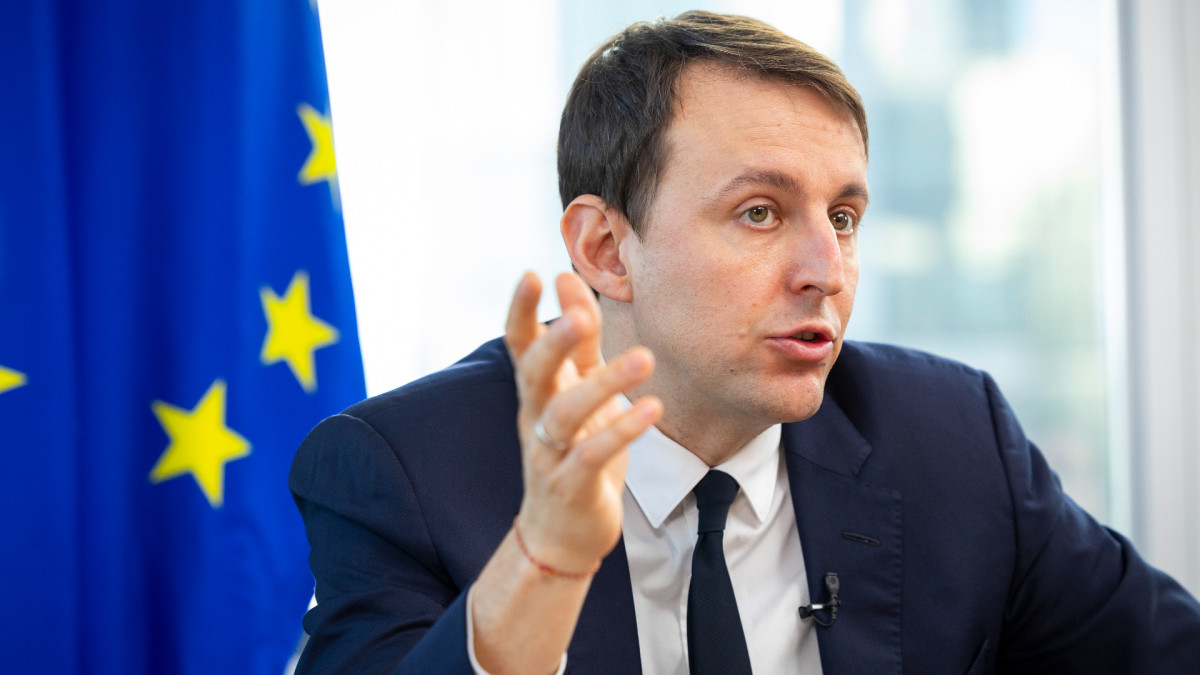
Javi López is part of the Socialists & Democrats group in the European Parliament. Photo: Agenda Pública / Bru Agency
Same question for you, Rosa, and let me add one more: what role has Ursula von der Leyen played in this?
R. B.: The debate in Brussels over the past six months is who to blame: member states or von der Leyen. But it’s a bit of a false debate, because von der Leyen was not alone in advocating appeasement. She had the backing of the EU member states. Otherwise, she wouldn’t have been able to pursue that.
We still see today that member states are wondering whether to activate the toolbox to respond to economic coercion from a foreign power: the anti-coercion instrument. EU leaders are going to meet on Thursday evening after Davos — after Trump’s speech and after attempts to de-escalate diplomatically — to decide whether to activate it or not.
"The fact that there are still so many differences among member states suggests the deeper problem: there is no unity on what transatlantic strategy to pursue"At the moment, there is no agreement over activating it. This instrument doesn’t require all 27 members to agree; it requires a qualified majority. There is a lot of pushback. Activating it doesn’t mean sanctioning the United States. It means enabling the Commission to take measures should the United States do something. In other words, it enables Europe to respond promptly.
It’s not as if someone is saying: "We want to pull out all euro savings from American banks." That’s not what the instrument is, and it’s not what activating it means.
But the fact that there are still so many differences among member states suggests the deeper problem: there is no unity on what transatlantic strategy to pursue. And there are several shades of positions among countries — it’s not two or three camps — which makes the calculus very difficult.
Commissioner Kubilius has started talking about the need for a European army. Is he putting that idea forward on his own, or is someone pushing him to put it on the table?
J. L.: I think he is trying to send a political message: that the horizon for Europe has to be taking full responsibility for our common security with our own common instruments. That’s what he’s projecting with the proposal.
A European army is something I would love to see one day. But it’s basically talking about the last piece of the castle when you haven’t started working on the pillars of the house. There are many things to do before we get there.
Interoperability is a problem. Our defense industry and our dependency are a problem. Coordination on intelligence and shared intelligence is a problem. We can do more. We can spend more on security. The last step of this long journey would be imagining a European army. But we have to spend better, and we have to spend more European.
R. B.: Totally. Now that we’re talking about increasing defense spending, for European citizens it’s really important to know that this money is well spent.
We don’t want Spain, France, and Germany all to buy the same things. They need to buy things that can work together, so we can focus on what is called interoperability. That creates efficiencies in cost, but also in deterrence and in action, if need be.
The European army is a recurrent theme. If you go back to the 1950s, the original idea was to create a defense community, which didn’t pass in the French Parliament. But that was where the whole idea of European integration started from. Then 10 or 15 years ago, Jean-Claude Juncker also talked about a European army.
It’s one of those myths that is going to be really hard to implement, because you need bottom-up integration before you can even imagine a European army. And sometimes that idea has actually backfired.
In Juncker’s case, it was very present in the Brexit debate. For some British voters, the idea reinforced the perception of Europe as a supranational force that was going to demolish national identity. It fed Euroscepticism.
A European army presupposes a movement towards a federal Europe. We’re not there. I don’t see any political leader willing to invest in that right now. In fact, quite the contrary: national leaders are downplaying the European Union.
None of them are willing to go out and face the electorate on a pro-European platform. That’s one of the problems we have. It’s not just the radical right parties: even the pro-European parties are not saying it loudly. And that needs to change.
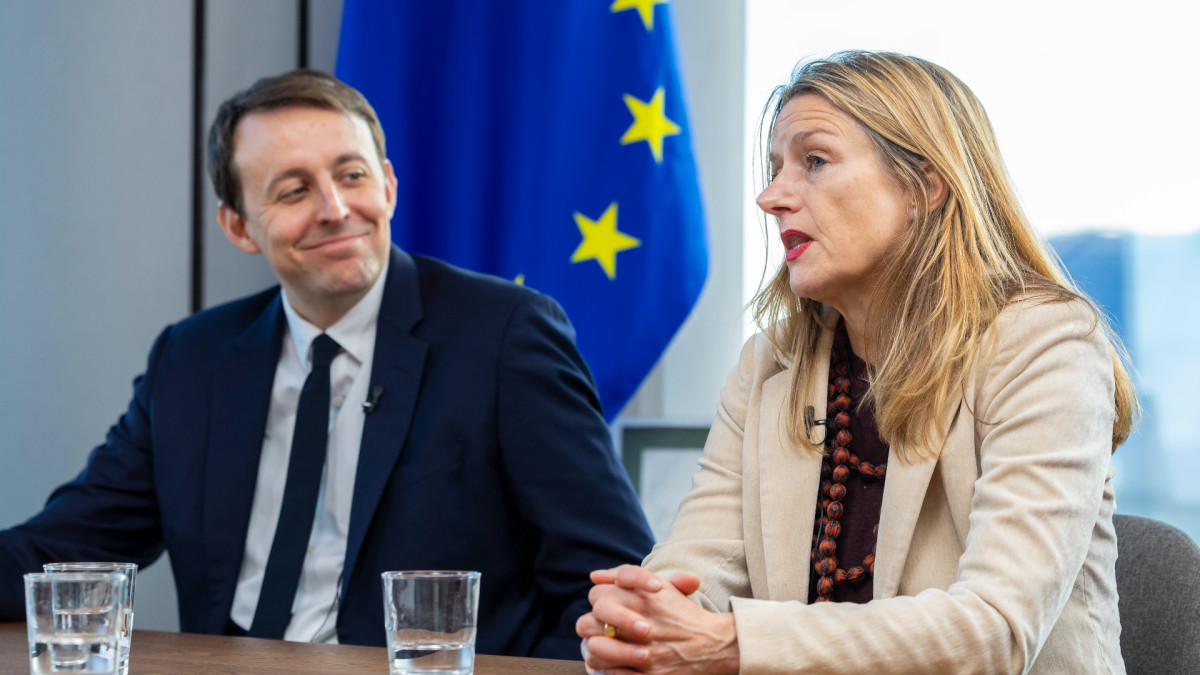
López and Balfour speak with 'Agenda Pública' at the European Parliament. Photo: Agenda Pública / Bru Agency
Let’s talk about national leaders: it’s not the same voice from Giorgia Meloni, Pedro Sánchez, Friedrich Merz, or Emmanuel Macron. How do these different positions affect Europe’s ability to build unity?
J. L.: We have a diverse Europe, politically and geographically. At the same time, Spain has continued contributing to key decisions made by the European Council and by Europe.
In any case, we have to find a collective way to produce common answers to this situation: to increase our deterrence — including deterrence vis-à-vis the United States — and to face what is an existential threat for our security: Ukraine.
"We have a diverse Europe, it’s true. But our prime ministers have to find a way to produce answers, especially this year"A few weeks ago, around Christmas, the idea in Europe was: maybe we can get an outcome for Ukraine. And suddenly, we are starting the year talking about the territorial integrity of Denmark, because it could be broken by the United States, our closest ally during the last century.
This is the reality. We have a diverse Europe, it’s true. But our prime ministers have to find a way to produce answers, especially this year, because next year will be a very electoral year in Europe.
Poland, France, Italy…
J. L.: And Spain. Four out of five biggest countries. That will make decisions even more difficult next year. That’s why this year is the year to move forward on protecting our sovereignty and to change what we see is not working. Now is the time to deepen the Single Market, our strongest instrument to boost competitiveness and prosperity, and to diversify our international alliances and partnerships.
We also need to strengthen the protection of our democracy against foreign interference, enforce digital market regulation, and mobilise both private and public investment towards innovation and our strategic objectives.
This is precisely why our debate on the European budget is so crucial.
R. B.: Of the five countries you mentioned, four of their leaders come from different political families. It’s always going to be difficult to find agreements.
Beyond that, Macron has been prominent in the debate about the future of Europe, but he doesn’t have sufficient backing at home. Then we see Chancellor Merz. Germany has always been very pro-European, but Merz is not really investing heavily in rhetorical support of Europe. He frames what needs to be done as something for Germany, not for Europe. That is a change in the way German politicians talk about domestic reforms, and it’s a problem.
The Italian Prime Minister, Meloni, speaks two, three, four different languages politically. She’s pro-Trumpian — a Trumpian — and then she says things to keep her role in the European framework. She’s very good at double speak, but she is not pro-European. Her commitment to Europe only goes as far as Europe delivers what she wants.
Italy is benefiting enormously from the Next Generation recovery plan set in motion because of COVID, under the previous government. She has room for maneuver and strong polling. The others are fighting the challenge from the radical right. She is the radical right, so she doesn’t have that problem.
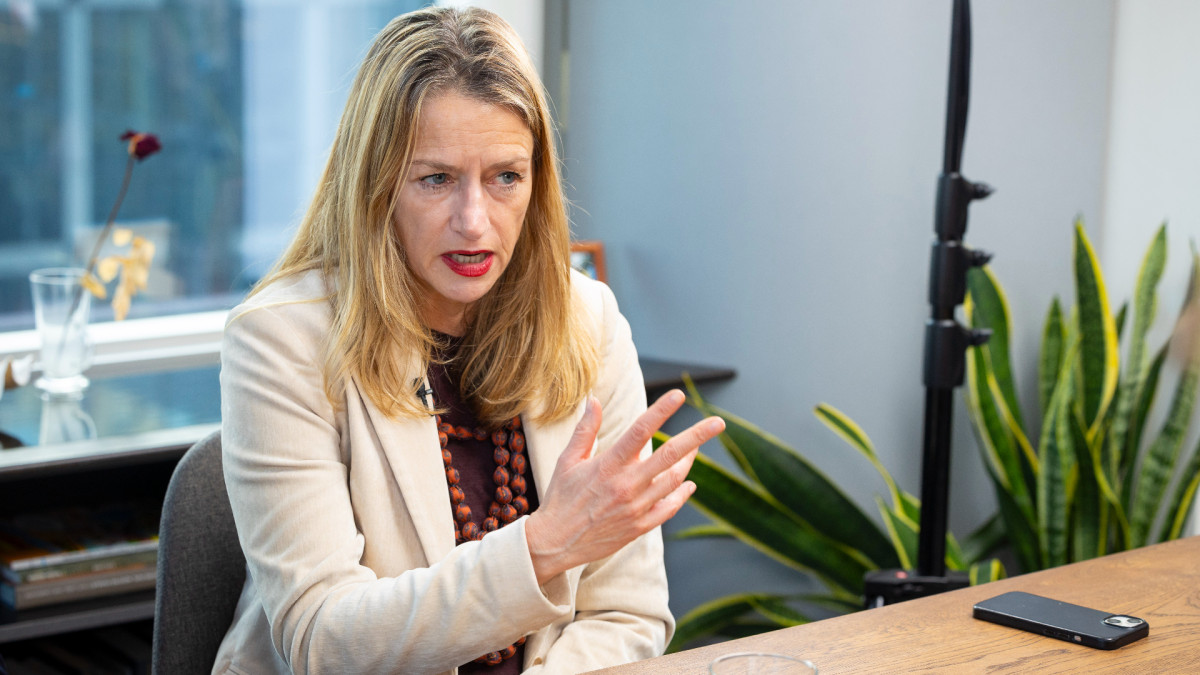
Rosa Balfour is an expert on European politics and institutions, and on security. Photo: Agenda Pública / Bru Agency
Let’s stay with that.
J. L.: One of the challenges is the story of German mercantilism, and a historical discomfort with power politics. They see power politics as something ugly. Foreign policy becomes about buying cars and selling energy. But we have to adapt to a new reality.
And with Germany, but also with the East of Europe, we have to face a reality: transatlantic relations are part of national identity. It’s not just foreign policy.
Poland, for example.
J. L.: And it’s something to respect, but also something that has to change. The current situation mandates not only policy changes, but also a mindset change. And changing mindset is always harder than changing policies, especially when it’s tied to national identity, and especially for people for whom the transatlantic relationship explains the existence of your country and your democracy.
"Spain played a really consistent position last year [...] Europe first. International law as our guide in the international scenario"When it comes to France, I often agree with President Macron’s narrative, but it tends to be pro-European when it aligns with French interests. We have to deal with French souverainism. We saw it with the Mercosur Agreement. One of the most important stress tests for Europe’s strategic autonomy was the EU-Mercosur Agreement. It was a clear path in that direction. Who was the biggest problem in that process? France.
And then we have Meloni’s double cards. That may have been useful last year, but taking into account the situation we are facing with Greenland, it’s not possible anymore.
On that, I think Spain played a really consistent position last year, backed by Spanish society, a really pro-European. Europe first. International law as our guide in the international scenario. We cannot use different standards for Ukraine, Gaza, Venezuela, the United States, and so on — something we saw last year. And we have to be firm with our American friends.
Rosa Balfour, Europe Director at the Carnegie Endowment for International Peace, during the conversation. Foto: Bru Agency
Let’s move to Ukraine. Could a peace agreement include a fast track for Ukraine to join the European Union? Would that be the real test for Europe?
R. B.: I agree that Ukraine’s accession to the European Union is a real test for Europe. But I don’t think it’s going to be a key element of whatever ceasefire agreement is reached. The key will be security guarantees.
Accession to the European Union can be interpreted as a security guarantee, but that’s not what Ukraine wants, and it’s not what would prevent Russia from invading again. And indeed, if Ukraine joins the European Union, Russia claims to be agnostic.
"We also need to be aware that enlargement has gone through many political challenges, including vetoes by individual EU members — not only on Ukraine"We all know that back in 2013-14, when the then president of Ukraine did not sign the deep and comprehensive free trade agreement and Ukrainians took to the streets, Yanukovych called Putin, and Putin had people shot. Thirteen years ago, it was unacceptable from the Russian perspective for Ukraine to have even a free trade agreement with the European Union.
But that’s what Moscow says now. That’s not the issue. The real issue is security guarantees.
There is discussion about whether Ukraine could have some accelerated path to accession. I don’t think that’s possible politically and legally, and it will probably cause more problems than it solves.
We also need to be aware that enlargement has gone through many political challenges, including vetoes by individual EU members — not only on Ukraine, but also on the Western Balkans.
That’s why the idea of gradual integration is taking hold. It means countries that aspire to join can join parts of the acquis and get some rights as they do so, but not all of them until they complete the whole process and there is a political understanding.
That’s the realistic scenario — slightly optimistic too, because it requires all countries to agree. But it’s more realistic than a quick path for Ukraine while the Western Balkans and Moldova stay out. Even geopolitically, I don’t think that’s realistic.
One last topic: China. We’re talking a lot about the United States, but in 10 years, will we talk about China in the same way?
J. L.: It’s possible, but our relations are completely different. Our security was built over the last years under the American umbrella. Even our international position and identity was built partly thanks to Atlantic relations. Our relations with China are not the same.
What is extremely important now, and I want to end with this, is to avoid at any cost the reflex of "the West and the rest". I sometimes see that reflex in Brussels. A worldview of "the West versus the rest", which partly reflects a Cold War mindset, would be a direct path to isolation.
Carney made good points in Davos: not picking blocks, explicitly, but defending our interests. Not being naive with China, defending our interests with China, but defending our interests in this new international scenario includes work in our relationship with China.
Thank you both.
Ahora en portada
27 de septiembre de 2026
26 de septiembre de 2026
Lo más leído