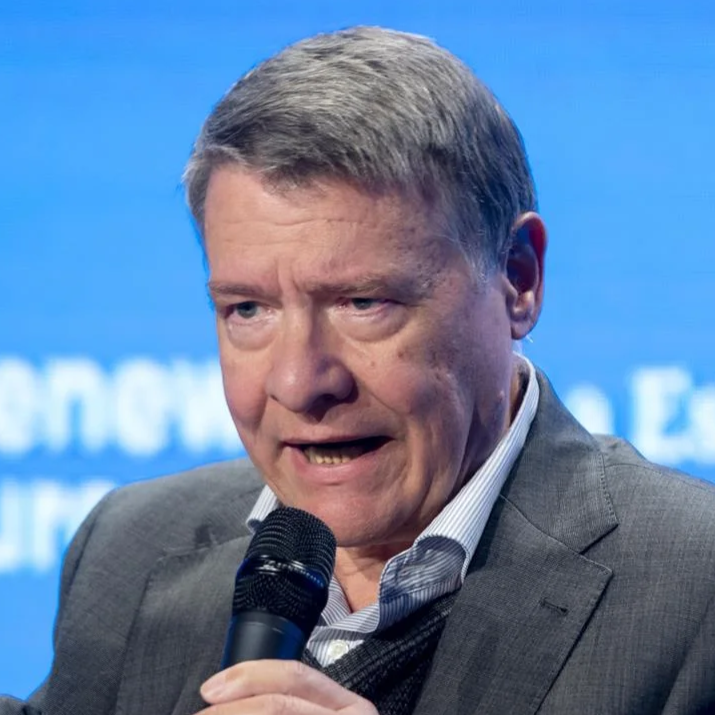


This text is a fragment from 'Manifest for a Radical Democracy' (Deusto), by Jordi Sevilla
Two challenges threaten the survival of humanity as we have known it so far: ecological catastrophe and artificial intelligence. Both are the consequence of human actions driven by the pursuit of private enrichment. Capitalism, as we have known it, in its neoliberal version, has proven to have predatory effects on the planet, destructive for the human race. It likewise generates levels of inequality and other social gaps that are incompatible with the democratic political system.
We lack effective instruments to confront either of these two global challenges, to which we can only oppose voluntary commitments from nation states, which are useless, given their size and functions, for this challenge that overwhelms them.
[Receive the most up-to-date analysis to your email or mobile through our Telegram channel]
There is thus an urgent need for a paradigm shift in the practical instrumentalisation of political action, understood not as the pursuit of power, but as one that aims to solve citizens’ problems. At various levels: broadening national democracy; creating a constitution and a system of global governance; changing the objectives of the economic system towards something similar to the UN Sustainable Development Goals, and reforming selfish capitalism towards what is being called stakeholder capitalism, with purposeful companies concerned with a positive social and natural impact of their actions, willing to comply with the Ten Principles of the UN Global Compact, and an enterprising and protective state that makes efficiency and data the centrepiece of its policies.A change that requires revisiting the old dichotomies between public and private, between individual and collective, or between left and right, because all options must now be aligned within the framework of shared responsibilities.
Without an Earth Constitution and a system of global governance based on the principles of radical democracy from an economic system with aligned social purpose, it will be impossible to successfully address the threats of climate change and artificial intelligence, human rights violations, or the Sustainable Development Goals (SDGs).
I call all this Radical Democracy, which is increasingly seen, not only as the best of the possible alternatives for coexistence in and among plural and diverse societies but also, increasingly, as the only real option in the face of the chaos that hangs over our heads.I defend a radical democracy, in the sense of going to the root. An aspirational proposal that leads us to strengthen the current mechanisms, deteriorated by populism, and to move towards a wider and deeper, but also more demanding, democracy. A complex democracy that begins by defending a radical application of what constitutes its constituent principles:
As Much Real Freedom as PossibleBecause without freedom there is no democracy, freedom as a right of citizenship. Not only equal political rights, but also equal access to a basic package of social rights. Freedom to carry out the life project of one’s choice and with whom one chooses, which requires guaranteeing the material conditions to make this possible, among others, a basic citizenship income that, although not linked to the level of income, helps to reorganise the tax system and social transfers.
As Much Effective Equality as NecessaryIt is necessary to deepen equal opportunity policies by introducing discriminations that favour the poorest but disadvantage the richest (through inheritance and wealth taxes). None of this contradicts the demand for personal effort and responsibility, which can only be ethically enforceable on the basis of (greater) equality in the starting conditions.
Nor can we lose sight of a certain equality of performance that avoids extreme and unjustifiable situations of unequal pay or wealth that are not attributable exclusively to effort, personal talent, or luck but are a consequence of one’s place in society and the specific rights that derive from these privileged positions.
With New Formulas for Social ParticipationLet us try formulas such as open government, or civic space, an enabling environment for civil society to play an active role in political, economic, and social life. For this to be possible, basic civil rights, such as freedom of expression, association, and assembly, must function without restrictions.
Democracies can thus put in place a new institutional fabric that complements representative bodies, allowing citizens to have less reason to distrust their governments and, moreover, to be more successful in defining responses to new challenges.
With a Feminist ApproachWithout democracy there is no feminism and without feminism there is no radical democracy. A radical democracy is a society of equals, in which no one enjoys privileges on the basis of birth, sex, race, religion, or belief and in which sex does not determine a compulsory, immutable social role.
Radical democracy is either feminist for 99% of the world’s population or it will not be.
And Broadening Economic DemocracyThere is still plenty of scope for finding ways to broaden and deepen democracy in the economic sphere. One vector of democratisation in companies is the consolidation of what is known as the stakeholder company, which is obliged to involve not only workers but also customers and suppliers in its management.
With a Transnational and Planetary VisionWe have to pass the screen, extending democracy on an international scale in order to fully address global issues. There are global values, principles, and realities that cannot be parcelled out within national borders, so radical democracy must be expanded to reach the necessary and urgent global dimension.
We need a paradigm shift that deepens the values of democracy and makes them effectively global, applicable to the whole species as a mega-identity that includes us all in the same team. Believe in and apply human rights, starting with a profound revision of the relations between us and the planet.
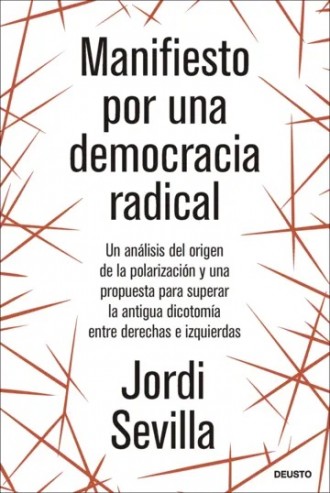
Pre-order 'Manifesto for a Radical Democracy' on Amazon
The proclamation of the 2030 Agenda and the Sustainable Development Goals represent two conceptual revolutions of great importance: they provide societies with a purpose that transcends GDP growth and provoke a radical change in the mission of companies, which cease to be profit maximisers for their owners (although being profitable is a necessary condition for not going bankrupt) and become concerned with the social value they provide, seeking a positive impact on all stakeholders.
Humanising digital transformation
The massive use of Artificial Intelligence by private companies has opened a global debate about its obvious benefits. But also, about its no less evident risks, especially of generative artificial intelligence, capable of evolving on its own in directions unknown to humans.
Does democracy have no say in these and similar far-reaching issues? It is about humanising digital transformation and placing the individual, his or her rights and freedoms, at the centre of any digital technology or process of change.
A ghost is once again haunting the world. The phantom of populism. Populism is a collective pathology that feeds on frustration and anger as a generalised stage of a society when disillusionment with unfulfilled promises and the lack of credibility of reformist alternatives coincide.
Its essence is polarisation, confrontation, the conversion of the adversary into an enemy, for which it systematically resorts, as a political strategy, to lies, insults, disqualification, humiliation, and mockery of the adversary. Hatred of the other becomes the norm with populism. That is why populism attacks democracy and democratic coexistence.
All this has been facilitated and enhanced by today’s social networks, which act as an amplifier. Populism permanently breaks the framework of democratic debate.
We are living through a new assault on reason. To understand how humans make decisions, we must take into account two realities that relativise their rational nature: the struggle for hegemony between the conscious (reason) and the unconscious (emotions), as well as the existence of the well-known cognitive biases that often cloud our judgement.
Nothing is as we were told. At this point in the century, three decades after the real beginning of the 21st century, when the 20th century came to an end with the fall of the Berlin Wall (1989) and the collapse of the Soviet Union (1991), things are not as promised by that neoliberalism that felt itself triumphant over communism. At last, it was said, historical reality was confirming the political, economic, and social theses of neoliberalism. And this has not been the case.
After filling them with erroneous beliefs and unfulfillable promises, the failure of neoliberalism has done great harm to human beings.
Those of us who were hoping for a new reason around which to articulate this 21st century, full of problems and opportunities, have come up against the resurgence of emotions in their worst version – that which nourishes populism. But nothing can be built from divisive and confrontational discourses.
We are facing the risk of democracy and popular sovereignty being subsumed in partisan confrontation, like just another advertising message. We must straighten out a situation that brings us dangerously close to a scenario in which the sovereignty of the people will be the alibi for a more or less covert autocracy.
Today’s humans face the two species challenges, ecological crisis, and AI, with a quality of life and expectations infinitely better than any previous generation – despite the fact that there are many more of us.
But in the management of personal and social affairs, in the face of the failure of the neoliberal narrative, we have returned to times past: human nature does not seem to have changed that much and continues to be dominated by passions (the irrational) and confrontation (that which separates us).
This duality is part of our curse, but also of our hopes for improvement: if we maintain the prevalence of reason and cooperation in personal and social management, which have brought us so much success in other areas, things will be different, and utopias such as perpetual peace (Kant) or the real equality of all human beings in terms of rights and freedoms may come closer to our reality. That is what my bet for a Radical Democracy is all about. It is worth a try, no?
Se puede leer el artículo original en español