Lunes, 12 de octubre de 2026




CONVERSATIONS
Florence Gaub (NATO): "If you remain too focused on the present, you will pay a price in the future"
Can a democracy think long term when politics is focused on the next crisis? Florence Gaub, director of the Research Division at the NATO Defense College, explains how the Alliance works with future scenarios, why biases matter as much as data and what risks she sees in the relationship with Russia. "Wars begin before the first shot," she warns in this conversation with 'Agenda Pública's' director and editor, Marc López Plana.
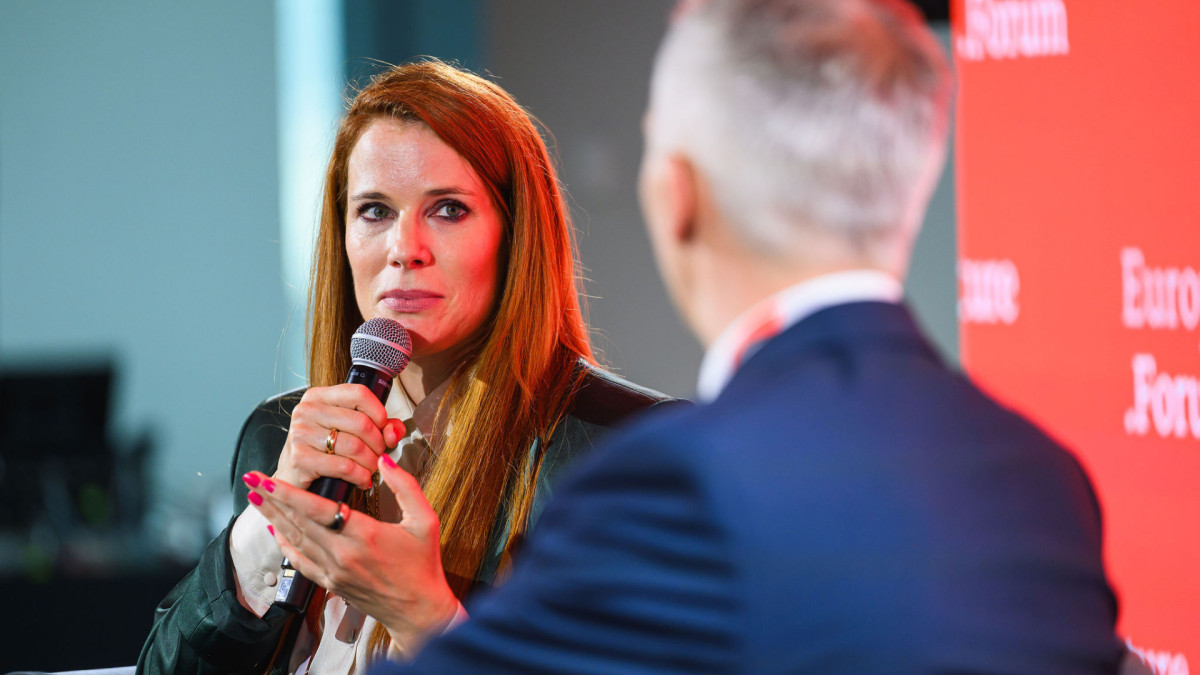
.jpg)
The director of the Research Division at the NATO Defense College at the 2026 EuropeFuture Forum.Courtesy photo.
Florence Gaub runs the Research Division at the NATO Defense College, where she contributes to the Alliance's strategic thinking. Against the conventional scenario of a Russian offensive against the Baltic states or Poland, she warns that an unintended escalation in the Arctic, the Mediterranean or the Black Sea could trigger a conflict: "To me, the conventional scenario is not the most likely one".
I had the chance to speak with her at the EuropeFuture Forum of Visegrad Insight this week in Warsaw. Gaub discusses how governments can think long term, the role played by psychological biases and how to tackle groupthink. From a Spanish perspective, she focuses on a Mediterranean shaped by the Russian presence and the vulnerability of critical infrastructure: "There needs to be a strategic shift in how we perceive NATO's southern flank".
Let me ask you first about your current job at NATO. What exactly do you do?
I run the Research Division at the NATO Defense College, which, in NATO institutional terms, is part of the military command structure. We fall under the Military Committee, so the Military Committee is our boss. The North Atlantic Council is the ultimate authority, and below that you have the Military Committee, where the highest-ranking military officers from all the member states sit. We report to them.
In practical terms, however, what the Research Division does is inform strategic-level thinking across NATO. We work with the Office of the Secretary General, ministries in member states, Allied Command Transformation, SACEUR, and so forth. Our job is to contribute to strategic-level thinking across the Alliance.
And you have a team?
We do. I have a team of ten people in total, both military personnel and civilians, from, I think, seven different countries at the moment. And we're in the process of growing, like everything in NATO. I always say I have the best job in NATO.
Is it possible to work with long-term scenarios when politicians may only have a four-year mandate?
When you correlate political systems with an index called intergenerational solidarity —which basically measures how far into the future a government works—, you see that democracies are perfectly capable of doing that, because they are normally committed to their people, and people care about the future. The leadership itself may not necessarily be interested, but citizens tend to elect and support politicians who run on an optimistic, positive vision of the future. Pedro Sánchez is clearly one case in point.
But, of course, there has been a tendency, especially over the last twenty years, towards less long-term thinking. You see a real decline around 2008. That could be related to the financial crisis; it could be related to the arrival of the smartphone. The present suddenly becomes much, much more important.
And I often hear: "Well, that's because we have so many crises, and we have to deal with the crisis first".
But I don't think it's an either-or choice. You have to be able to handle the crisis while also steering the boat in the right direction. It is true, however, that many bureaucracies struggle to do both.
My rule of thumb is that the higher the level of the decision-maker, the fewer scenarios they should see. For a prime minister, you give them two scenarios. You don't give them fifteen. A minister might be able to handle three, but that's about it.
More importantly, a scenario isn't simply about what could happen. You also have to tell decision-makers what they can do to avoid that scenario. At the end of the day, what do politicians want? They want to take action. They want to act.
So you have to give them ideas about what they can do to change the scenario. Many foresight practitioners don't want to do that. They say: "This is the future; now you go and deal with it". But the whole purpose of thinking about the future is to do something about it.
Politicians feel they have to react to everything. Is it still possible to think in terms of scenarios when you have to react every day to so many things that happen —or that we think are happening?
You have to. You have no other option.
There is a term for this: future discounting, the discounting of the future. If you remain too focused on the present, you will pay a price in the future. The analogy is that if you party too hard today, tomorrow you will pay the price. If you focus too much on whatever is happening in the present, there will eventually be a cost.
Now, of course, I'm not saying that you should think about the future every single day. I always say that, for a government —depending on what your business is—, you should probably do this once a year. Take the first week of January, for example, which is normally a week when there isn't a major crisis. Take your team aside and ask: What do we want to happen? What don't we want to happen? What precautions can we take? And then that thinking trickles down through the system.
I don't think it's that difficult. It's not as if you cannot find half a day to take your team aside.
I'll give you another example. Jens Stoltenberg's team, when he was Secretary General, met once a month to review their assumptions about Russia. It was an hour when they would sit down together and say: "To avoid being surprised, let's check our assumptions".
It's a kind of intellectual hygiene that is actually quite easy to practise. When people say, "I don't have time for this", it's a little like saying, "I don't have time to brush my teeth". It's not that you don't have the time; it's that you don't want to make time for it.
If Germany had worked seriously with scenarios many years ago, would it have decided not to become so dependent on Russian gas?
There is an interesting obstacle here, and it isn't unique to Germany. You can have the best foresight in the world, but if there is psychological resistance to your findings, it is useless.
In many cases, you discover afterwards that what happened wasn't really a black swan. Think about the pandemic, the invasion of Ukraine or September 11. There is almost always somebody who had anticipated it.
In Germany's case —and I say this as a German—, the psychological attachment to a world in which we could be friends with Russia was extraordinarily strong, precisely because of the Cold War and because of Germany's division.
When I grew up in Munich, we were always aware that if war broke out between the Soviet Union and the United States, this was where it was going to happen. You were constantly living under the shadow of war. And that came to an end in 1990.
So I think the psychological attachment to that sense of relief was simply too strong. There were people —including the Americans— saying, "Don't do this". But the bias was too strong. I don't think it could have been overcome simply through better foresight.
That's why we always say: check your biases, check your assumptions. And if you are deeply attached to an assumption, define in advance the circumstances under which you would be prepared to change your mind. Many people don't do that.
In many cases, politicians want to surround themselves with people who don't criticise the leader. If you want to work seriously with scenarios, you have to tackle a certain degree of groupthink. How do you do that?
I think you've put your finger on the real problem. Very often, people think that to become better at thinking about the future, we simply need more money, more information or more people. Nobody is going to say no to any of that. But the real problem is psychological. It is about all the different biases we have, and groupthink is itself a form of bias.
I think the best way to address this is to make sure you have a genuinely diverse group. And by diversity, I don't necessarily mean sexual orientation or things of that sort. It can mean age, political inclination, professional training. Economists see the world differently from political scientists. Personality matters as well.
The more diverse your team is —and many people don't think about diversity in those terms—, the more likely people are to learn from one another, and the more likely they are to question one another.
But, of course, all of this has to happen in a spirit of equality. Groupthink emerges when there is one very powerful person in the room and everyone else is reluctant to contradict them.
I always think the Research Division is a good example because we are, in a sense, protected. We are a small and very diverse team. Within the team, we often disagree, but it is a safe space. People are allowed to disagree. It isn't a problem. Nobody is going to get fired for expressing a different view.
So that would be my recommendation. And if you cannot create that environment within your immediate team, then create a small team like mine somewhere else in the organisation —one that is protected and has both the trust and the mandate to disagree.
Is the European Commission currently working with scenarios?
I would assume so. When I worked in the EU, it had a fairly well-established foresight system —ESPAS and the Global Trends Report, for example—. So I would assume that, yes, they are working with different scenarios.
But different institutions and bodies can have different scenarios, and that's perfectly fine. You don't need to have one single scenario for everybody. So I would imagine the EU is doing its own scenario work as well.
 If I asked you to outline the scenarios involving Russia, what would they be?
I think there is a conventional scenario. The conventional or generally accepted scenario —in the sense that this is what everybody assumes would happen if it happened— is that Russia attacks the Baltic states, Poland, or somewhere in that area. Classically, it looks a lot like Ukraine: tanks crossing the border, drones, and so forth.
When you put that together, however, you realise that it is essentially a recycling of previous war scenarios. Ukraine is obviously very recent and therefore extremely present in our minds, but it also resembles the old Cold War scenario. During the Cold War, the scenario was essentially the same, except that the frontline was somewhat further west.
That is essentially what NATO is currently preparing for. But I think there is a problem with our thinking. NATO's war scenarios tend to begin with the first shot being fired. But wars begin before the first shot.
What worries me at the moment is that we are not thinking enough about those stages, and therefore we could actually stumble into a war.
To me, the conventional scenario is not the most likely one. I think the more likely scenario could emerge in the Arctic, for instance, or perhaps even in the Mediterranean or the Black Sea. But let's focus on the Arctic. Imagine you have a British ship. A satellite malfunctions. The ship enters Russian territorial waters. Something happens. Shots are fired.
The North Atlantic Treaty also applies to vessels north of the Tropic of Cancer, so suddenly you potentially have an Article 5 situation that neither the United Kingdom nor Russia actually wanted.
This possibility of accidentally stumbling into a war worries me much more. The situation is now so tense that something can simply go wrong. Think of the dynamics that led to the First World War.
And suddenly you have an enormous mess on your hands. It might have started in the Arctic and then perhaps unfolds both in the Arctic and in space because satellites are involved. It might look nothing like the war we have actually prepared for. To me, that is the more likely scenario.
And it has much less to do with Russian tanks crossing the Polish border than with how both sides are looking at each other. Both sides increasingly expect the other side to do something.
And what happens when both sides are expecting something? When an incident occurs, you are more likely to assume that it was intentional.
Russia believes, oddly enough, that creating an atmosphere of war can actually prevent war. We don't think that way. So you essentially have two different strategic languages talking past each other.
From Spain, the Russian threat can feel distant, while Ceuta, Melilla and North Africa present more immediate vulnerabilities. Do you think Europe and NATO are paying enough attention to the Mediterranean as a strategic scenario?
Let me tell you a funny story. When the Cold War ended, JFC Naples [Joint Force Command Naples] carried out an assessment of what would have happened if the Soviet Union had attacked from the south.
They concluded that the chances of winning the war would actually have been much better for the Soviets in the south than in the east because, much as today, NATO was already looking east and not looking south.
There are a variety of reasons why NATO has this "southern blindness". But it isn't justified. It wasn't justified then, and it isn't justified now.
Russia has a port in Syria. Russia is on fairly good terms with Egypt. It is probably present in Libya and certainly elsewhere in Africa. It has just bought a shipyard in Morocco. Nobody really knows what they're going to do with that, but I would certainly put a question mark over it. There is also a slowly increasing presence of Russian ships in the Mediterranean, including aggressive shadowing —following vessels from NATO countries, for example—.
So it is high time we understood that the Mediterranean is not simply a friendly lake between Europe and North Africa. It is also an area containing critical infrastructure, including undersea cables, which will also be affected by climate change, submarine activity, storms and other factors.
So even if you look purely at the naval, military and maritime dimensions, there is a great deal happening there. It is really important that people understand that. There needs to be a strategic shift in how we perceive NATO's southern flank.
Thank you very much.
I had the chance to speak with her at the EuropeFuture Forum of Visegrad Insight this week in Warsaw. Gaub discusses how governments can think long term, the role played by psychological biases and how to tackle groupthink. From a Spanish perspective, she focuses on a Mediterranean shaped by the Russian presence and the vulnerability of critical infrastructure: "There needs to be a strategic shift in how we perceive NATO's southern flank".
Florence Gaub has worked at the General Secretariat of the Council and as a visiting professor at the College of Europe. Photo: Courtesy photo
Let me ask you first about your current job at NATO. What exactly do you do?
I run the Research Division at the NATO Defense College, which, in NATO institutional terms, is part of the military command structure. We fall under the Military Committee, so the Military Committee is our boss. The North Atlantic Council is the ultimate authority, and below that you have the Military Committee, where the highest-ranking military officers from all the member states sit. We report to them.
In practical terms, however, what the Research Division does is inform strategic-level thinking across NATO. We work with the Office of the Secretary General, ministries in member states, Allied Command Transformation, SACEUR, and so forth. Our job is to contribute to strategic-level thinking across the Alliance.
And you have a team?
We do. I have a team of ten people in total, both military personnel and civilians, from, I think, seven different countries at the moment. And we're in the process of growing, like everything in NATO. I always say I have the best job in NATO.
Is it possible to work with long-term scenarios when politicians may only have a four-year mandate?
When you correlate political systems with an index called intergenerational solidarity —which basically measures how far into the future a government works—, you see that democracies are perfectly capable of doing that, because they are normally committed to their people, and people care about the future. The leadership itself may not necessarily be interested, but citizens tend to elect and support politicians who run on an optimistic, positive vision of the future. Pedro Sánchez is clearly one case in point.
But, of course, there has been a tendency, especially over the last twenty years, towards less long-term thinking. You see a real decline around 2008. That could be related to the financial crisis; it could be related to the arrival of the smartphone. The present suddenly becomes much, much more important.
And I often hear: "Well, that's because we have so many crises, and we have to deal with the crisis first".
But I don't think it's an either-or choice. You have to be able to handle the crisis while also steering the boat in the right direction. It is true, however, that many bureaucracies struggle to do both.
"You have to be able to handle the crisis while also steering the boat in the right direction"There is also a trick to this. The fastest way to lose a leader's attention is to give them fifteen different scenarios and say: "All of this could happen". Our job as futurists working in the service of policymaking is to make their lives easier. It is not to tell them everything that could happen, because many more things can happen than actually will happen.
My rule of thumb is that the higher the level of the decision-maker, the fewer scenarios they should see. For a prime minister, you give them two scenarios. You don't give them fifteen. A minister might be able to handle three, but that's about it.
More importantly, a scenario isn't simply about what could happen. You also have to tell decision-makers what they can do to avoid that scenario. At the end of the day, what do politicians want? They want to take action. They want to act.
So you have to give them ideas about what they can do to change the scenario. Many foresight practitioners don't want to do that. They say: "This is the future; now you go and deal with it". But the whole purpose of thinking about the future is to do something about it.
Politicians feel they have to react to everything. Is it still possible to think in terms of scenarios when you have to react every day to so many things that happen —or that we think are happening?
You have to. You have no other option.
There is a term for this: future discounting, the discounting of the future. If you remain too focused on the present, you will pay a price in the future. The analogy is that if you party too hard today, tomorrow you will pay the price. If you focus too much on whatever is happening in the present, there will eventually be a cost.
Now, of course, I'm not saying that you should think about the future every single day. I always say that, for a government —depending on what your business is—, you should probably do this once a year. Take the first week of January, for example, which is normally a week when there isn't a major crisis. Take your team aside and ask: What do we want to happen? What don't we want to happen? What precautions can we take? And then that thinking trickles down through the system.
I don't think it's that difficult. It's not as if you cannot find half a day to take your team aside.
I'll give you another example. Jens Stoltenberg's team, when he was Secretary General, met once a month to review their assumptions about Russia. It was an hour when they would sit down together and say: "To avoid being surprised, let's check our assumptions".
It's a kind of intellectual hygiene that is actually quite easy to practise. When people say, "I don't have time for this", it's a little like saying, "I don't have time to brush my teeth". It's not that you don't have the time; it's that you don't want to make time for it.
If Germany had worked seriously with scenarios many years ago, would it have decided not to become so dependent on Russian gas?
There is an interesting obstacle here, and it isn't unique to Germany. You can have the best foresight in the world, but if there is psychological resistance to your findings, it is useless.
In many cases, you discover afterwards that what happened wasn't really a black swan. Think about the pandemic, the invasion of Ukraine or September 11. There is almost always somebody who had anticipated it.
"You can have the best foresight in the world, but if there is psychological resistance to your findings, it is useless"I mean, something resembling September 11 even appears in a Tom Clancy novel. So it wasn't as though one single guy sitting alone in a hut somewhere was the only person who had ever thought about it. In most cases, somebody knew; somebody had considered the possibility. But then, at the higher political level, there was resistance.
In Germany's case —and I say this as a German—, the psychological attachment to a world in which we could be friends with Russia was extraordinarily strong, precisely because of the Cold War and because of Germany's division.
When I grew up in Munich, we were always aware that if war broke out between the Soviet Union and the United States, this was where it was going to happen. You were constantly living under the shadow of war. And that came to an end in 1990.
So I think the psychological attachment to that sense of relief was simply too strong. There were people —including the Americans— saying, "Don't do this". But the bias was too strong. I don't think it could have been overcome simply through better foresight.
That's why we always say: check your biases, check your assumptions. And if you are deeply attached to an assumption, define in advance the circumstances under which you would be prepared to change your mind. Many people don't do that.
In many cases, politicians want to surround themselves with people who don't criticise the leader. If you want to work seriously with scenarios, you have to tackle a certain degree of groupthink. How do you do that?
I think you've put your finger on the real problem. Very often, people think that to become better at thinking about the future, we simply need more money, more information or more people. Nobody is going to say no to any of that. But the real problem is psychological. It is about all the different biases we have, and groupthink is itself a form of bias.
"The real problem is psychological. It is about all the different biases we have, and groupthink is itself a form of bias"What works is creating an environment in which dissenting voices are allowed. That is difficult, especially in highly hierarchical structures —the military, for example—, but also in certain cultures that are particularly hierarchical. And it becomes even more difficult when there is a strong personal attachment to a particular outcome, as was the case with Germany.
I think the best way to address this is to make sure you have a genuinely diverse group. And by diversity, I don't necessarily mean sexual orientation or things of that sort. It can mean age, political inclination, professional training. Economists see the world differently from political scientists. Personality matters as well.
The more diverse your team is —and many people don't think about diversity in those terms—, the more likely people are to learn from one another, and the more likely they are to question one another.
But, of course, all of this has to happen in a spirit of equality. Groupthink emerges when there is one very powerful person in the room and everyone else is reluctant to contradict them.
I always think the Research Division is a good example because we are, in a sense, protected. We are a small and very diverse team. Within the team, we often disagree, but it is a safe space. People are allowed to disagree. It isn't a problem. Nobody is going to get fired for expressing a different view.
So that would be my recommendation. And if you cannot create that environment within your immediate team, then create a small team like mine somewhere else in the organisation —one that is protected and has both the trust and the mandate to disagree.
Is the European Commission currently working with scenarios?
I would assume so. When I worked in the EU, it had a fairly well-established foresight system —ESPAS and the Global Trends Report, for example—. So I would assume that, yes, they are working with different scenarios.
But different institutions and bodies can have different scenarios, and that's perfectly fine. You don't need to have one single scenario for everybody. So I would imagine the EU is doing its own scenario work as well.
ARTÍCULOS RELACIONADOS
Hedda Langemyr, directora de UTSYN, el Centro para la Seguridad y la Defensa Total noruego.Imagen cedida

Teija Tiilikainen y Ruth Ferrero conversaron en Madrid sobre las funciones del 'Hybrid CoE'.Agenda Pública / Tania Sieira
I think there is a conventional scenario. The conventional or generally accepted scenario —in the sense that this is what everybody assumes would happen if it happened— is that Russia attacks the Baltic states, Poland, or somewhere in that area. Classically, it looks a lot like Ukraine: tanks crossing the border, drones, and so forth.
When you put that together, however, you realise that it is essentially a recycling of previous war scenarios. Ukraine is obviously very recent and therefore extremely present in our minds, but it also resembles the old Cold War scenario. During the Cold War, the scenario was essentially the same, except that the frontline was somewhat further west.
That is essentially what NATO is currently preparing for. But I think there is a problem with our thinking. NATO's war scenarios tend to begin with the first shot being fired. But wars begin before the first shot.
"NATO's war scenarios tend to begin with the first shot being fired. But wars begin before the first shot"You mentioned escalation. I don't think we think enough about escalation in the sense of asking: When do you actually notice that it is happening? What are the steps that take place beforehand?
What worries me at the moment is that we are not thinking enough about those stages, and therefore we could actually stumble into a war.
To me, the conventional scenario is not the most likely one. I think the more likely scenario could emerge in the Arctic, for instance, or perhaps even in the Mediterranean or the Black Sea. But let's focus on the Arctic. Imagine you have a British ship. A satellite malfunctions. The ship enters Russian territorial waters. Something happens. Shots are fired.
The North Atlantic Treaty also applies to vessels north of the Tropic of Cancer, so suddenly you potentially have an Article 5 situation that neither the United Kingdom nor Russia actually wanted.
This possibility of accidentally stumbling into a war worries me much more. The situation is now so tense that something can simply go wrong. Think of the dynamics that led to the First World War.
And suddenly you have an enormous mess on your hands. It might have started in the Arctic and then perhaps unfolds both in the Arctic and in space because satellites are involved. It might look nothing like the war we have actually prepared for. To me, that is the more likely scenario.
And it has much less to do with Russian tanks crossing the Polish border than with how both sides are looking at each other. Both sides increasingly expect the other side to do something.
And what happens when both sides are expecting something? When an incident occurs, you are more likely to assume that it was intentional.
"This possibility of accidentally stumbling into a war worries me much more. The situation is now so tense that something can simply go wrong"Everything you said about us already being at war with Russia doesn't necessarily help, because it also contributes to this tension —to the assumption that whatever Russia does is probably malicious or intentional. I'm not saying whether that assumption is right or wrong. I'm saying that this is how we increasingly perceive things.
Russia believes, oddly enough, that creating an atmosphere of war can actually prevent war. We don't think that way. So you essentially have two different strategic languages talking past each other.
From Spain, the Russian threat can feel distant, while Ceuta, Melilla and North Africa present more immediate vulnerabilities. Do you think Europe and NATO are paying enough attention to the Mediterranean as a strategic scenario?
Let me tell you a funny story. When the Cold War ended, JFC Naples [Joint Force Command Naples] carried out an assessment of what would have happened if the Soviet Union had attacked from the south.
They concluded that the chances of winning the war would actually have been much better for the Soviets in the south than in the east because, much as today, NATO was already looking east and not looking south.
There are a variety of reasons why NATO has this "southern blindness". But it isn't justified. It wasn't justified then, and it isn't justified now.
"There are a variety of reasons why NATO has this «southern blindness». But it isn't justified. It wasn't justified then, and it isn't justified now"I think it is extremely important for NATO as a whole —and for Europe as a whole— to understand that the Mediterranean is not simply a friendly sea connecting us with our Middle Eastern and North African neighbours. It isn't only about Mediterranean Dialogue, state-building and capacity-building. All of that is valuable, of course, but there is another strategic reality.
Russia has a port in Syria. Russia is on fairly good terms with Egypt. It is probably present in Libya and certainly elsewhere in Africa. It has just bought a shipyard in Morocco. Nobody really knows what they're going to do with that, but I would certainly put a question mark over it. There is also a slowly increasing presence of Russian ships in the Mediterranean, including aggressive shadowing —following vessels from NATO countries, for example—.
So it is high time we understood that the Mediterranean is not simply a friendly lake between Europe and North Africa. It is also an area containing critical infrastructure, including undersea cables, which will also be affected by climate change, submarine activity, storms and other factors.
So even if you look purely at the naval, military and maritime dimensions, there is a great deal happening there. It is really important that people understand that. There needs to be a strategic shift in how we perceive NATO's southern flank.
Thank you very much.
Etiquetas
Conversaciones (ENG), Agenda Pública in English, Guerra Híbrida, Otan, prospectiva, Futuro, Rusia, Ucrania, España, Mediterráneo, Alemania, Europa Ahora en portada
11 de octubre de 2026
10 de octubre de 2026
Noticias relacionadas
Hace 49 semanas
La directora del 'think tank' noruego de seguridad y defensa: "Europa atraviesa una fase de inestabilidad de largo recorrido"
Hace 54 semanas
La referencia europea contra amenazas híbridas: "Rusia, China e Irán buscan debilitar a Occidente"
Hace 14 semanas